
When a couple faces difficulty conceiving, one of the most confusing parts is understanding the different fertility treatments available. Terms like IUI, IVF, and ICSI are often used, but what do they really mean—and how do you know which one is right for you? Let’s break it down in simple language.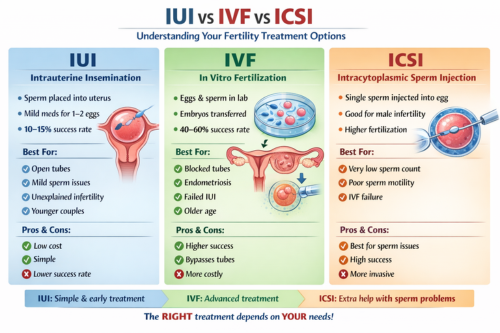
IUI – Intrauterine Insemination
What it is: IUI is the simplest form of fertility treatment. In this procedure, specially prepared sperm is placed directly into the uterus around the time of ovulation.
What happens: The woman may take mild fertility tablets or injections to produce 1–2 eggs. When the egg is ready, the man gives a semen sample. The healthiest sperm are selected and gently injected into the uterus using a thin catheter.
Who benefits most:
IUI works best when:
- The woman has open fallopian tubes.
- The man has mild sperm issues.
- There is unexplained infertility.
- The couple is young and infertility duration is short.
Success rate: Typically, 10–15% per cycle.
Advantages:
- Simple
- Low-cost
- Minimal injections
- Almost painless
Limitations:
Since fertilization still happens naturally inside the body, success is limited if sperm quality is poor, tubes are blocked, or age is higher.
IVF – In Vitro Fertilization
What it is: IVF means fertilization happens outside the body in a laboratory.
What happens:
The woman takes hormone injections to produce multiple eggs. These eggs are retrieved under short anesthesia. The eggs are then mixed with sperm in the lab. After fertilization, embryos are grown for a few days and one or two are transferred into the uterus.
Who benefits most
IVF is advised when:
- Fallopian tubes are blocked
- Endometriosis is present
- IUI has failed
- Age is higher
- Egg count or egg quality is low
- Sperm count or motility is poor
Success rate: Usually 40–60% per cycle in younger women. Advantages: Bypasses tubes Better control over fertilization Higher success than IUI
Limitations:
More expensive and involves injections and procedures.
ICSI (Often called “IXI”) or Intracytoplasmic Sperm Injection:
Many people say “IXI”, but the correct term is ICSI.
What it is:
ICSI is a special form of IVF where a single healthy sperm is injected directly into each egg.
What happens:
Eggs are collected just like IVF. But instead of letting sperm swim to the egg, the embryologist picks one sperm and injects it into the egg using a microscopic needle.
Who needs ICSI?
ICSI is used when:
- Sperm count is very low
- Sperm movement is poor
- Sperm shape is abnormal
- Previous IVF had fertilization failure
- Surgical sperm is used
Success rate: Fertilization rates are higher than regular IVF when sperm quality is poor. So which one is right for you? IUI is for mild problems and early treatment. IVF is for more complex infertility or after IUI failure. ICSI is IVF with extra help when sperm problems exist.
Therefore, there is no “better” or “worse” treatment—only the right treatment for the right couple. A proper fertility evaluation helps decide the safest, most effective, and most economical path to pregnancy.