
IVF success rates are often quoted as 50%, 70%, or even 90%, and while these numbers can sound reassuring, they can also be misleading. The most important thing to understand is that there is no single success rate in IVF. Success depends on multiple individual factors, and each patient’s chances are different.
Why IVF Success Rates Vary
The most critical factor is age. As a woman’s age increases, egg quality declines, directly impacting IVF outcomes. However, even within the same age group, success varies depending on: 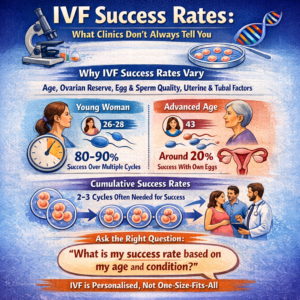
- Ovarian reserve: measured by AMH (Anti-Müllerian Hormone) and Antral Follicle Count (AFC)
- Egg quality: closely linked to age
- Sperm quality: count, motility, and morphology
- Endometrial thickness and receptivity
Uterine and tubal - factors: such as fibroids or hydrosalpinx
Because of these variables, it is not scientifically correct to give a blanket success rate to all patients.
Realistic Expectations: Young vs Advanced Age
- For example, a 26–28-year-old woman with:
Good AMH - Healthy endometrium
- Normal sperm
- IVF for tubal blockage
may have a cumulative pregnancy rate of 80–90% over multiple embryo transfers.
In contrast, a 43-year-old woman with AMH of 0.2 may have:
Cumulative success rate of around 20% or less using her own eggs
These differences are driven by biology, not by the clinic alone.
Understanding Cumulative Success:
- Another important concept is cumulative pregnancy rate.
- IVF is not always successful in a single attempt. Many couples may need:
- 2–3 embryo transfers or cycles
When we say 80–90% success, it usually means that:
Out of 10 similar patients, 8–9 may achieve pregnancy over multiple attempts, not necessarily in the first cycle.
What Clinics May Not Always Tell You
- Some clinics may:
Quote high success rates based on selected patient groups - Focus on positive pregnancy tests rather than live births
- Avoid explaining the need for multiple cycles
This can create unrealistic expectations.
The Right Question to Ask
Instead of asking:
“What is your success rate?”
Patients should ask:
“What is my success rate based on my age and clinical condition?”
Final Takeaway
IVF success is not a fixed percentage—it is a personalised probability. Honest counselling, realistic expectations, and patient-specific planning are essential for the best outcomes.
References:
Smith ADAC, et al. Live-birth rate associated with repeat IVF cycles. JAMA. 2015.
Sunkara SK, et al. Association between AMH and IVF outcomes. Hum Reprod. 2011.
Broer SL, et al. Ovarian reserve markers and reproductive outcomes. Hum Reprod Update. 2014.
References (Vancouver style)
Smith ADAC, et al. Live-birth rate associated with repeat IVF cycles. JAMA. 2015.
Sunkara SK, et al. Association between AMH and IVF outcomes. Hum Reprod. 2011.
Broer SL, et al. Ovarian reserve markers and reproductive outcomes. Hum Reprod Update. 2014.