
Blocked fallopian tubes are one of the most common causes of female infertility. The fallopian tubes play a crucial role in natural conception—they are the site where the sperm meets the egg and fertilization occurs. When the tubes are blocked, this meeting cannot happen, making natural pregnancy difficult or impossible. 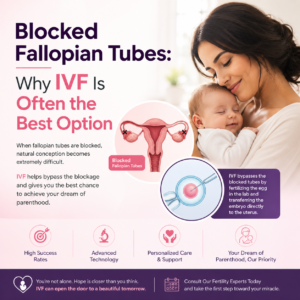
What Does a “Blocked Tube” Mean?
A common test used to assess tubal patency is HSG (Hysterosalpingography). However, it is important to understand that an HSG report showing blocked tubes does not always mean a permanent blockage.
There are three possibilities:
- True blockage: due to infection, endometriosis, or adhesions
- Tubal spasm: temporary tightening of the tube during the test
- Cornual block: blockage at the uterine end of the tube
Therefore, HSG findings must always be interpreted in the clinical context.
When Laparoscopy May Help
In selected patients, especially those who are:
- Young (below 35 years)
- Have good ovarian reserve and egg quality
- Have normal sperm parameters
a diagnostic laparoscopy can be considered.
During laparoscopy:
- Tubes can be directly visualised
- Minor adhesions can be released
- Cornual blocks may sometimes be corrected
- Tubal patency can be reassessed
In some cases, this may restore the chance of natural conception.
When IVF Is the Better Option
However, IVF is often the more effective and time-efficient option, particularly when:
- The woman is above 35 years
- There is a long duration of infertility (>2–3 years)
- Egg quality or ovarian reserve is reduced
- Sperm quality is suboptimal
- There is a history of pelvic infection or severe endometriosis
In these situations, spending time on surgery may delay treatment without significantly improving outcomes.
IVF bypasses the fallopian tubes entirely by:
- Retrieving eggs from the ovaries
- Fertilising them in the laboratory
- Transferring embryos directly into the uterus
Role of Laparoscopy in Advanced Disease
Even when laparoscopy is performed, findings may include:
- Severely damaged tubes
- Dense adhesions or frozen pelvis
- Distorted pelvic anatomy
In such cases, reconstructive surgery is often not feasible or successful, and IVF becomes the definitive treatment.
Hydrosalpinx: A Special Situation
One important condition is hydrosalpinx, where fluid collects in a blocked tube. This fluid can:
- Leak back into the uterus
- Negatively affect embryo implantation
During laparoscopy, if hydrosalpinx is detected, it is recommended to:
- Clip or remove the affected tube (salpingectomy)
This has been shown to significantly improve IVF success rates.
Balancing Time and Treatment
The key in managing tubal infertility is individualised decision-making.
- In younger patients with good prognosis, laparoscopy may be considered
- In older patients or those with multiple factors, IVF should be prioritised early
Delaying IVF in such cases may result in loss of valuable reproductive time.
Final Takeaway
Blocked fallopian tubes do not always require immediate IVF, but in many cases, IVF offers the highest chance of success in the shortest time.
The decision should not be based on a single test, but on:
- Age
- Duration of infertility
- Egg and sperm quality
- Overall pelvic condition
A well-timed, individualised approach ensures the best possible outcome.
References
- Practice Committee of ASRM. Role of tubal surgery in the era of assisted reproductive technology. Fertil Steril. 2021.
- Johnson NP, et al. Surgical treatment for tubal infertility. Cochrane Database Syst Rev. 2010.
- Strandell A, et al. Hydrosalpinx and IVF outcome: a prospective randomized study. Hum Reprod. 1999.
- Zeyneloglu HB, et al. The impact of hydrosalpinx on IVF outcome. Fertil Steril. 1998.
- Pandian Z, et al. In vitro fertilisation for tubal infertility. Cochrane Database Syst Rev. 2015.
- Swart P, et al. Tubal pathology and fertility outcomes. Hum Reprod Update. 1995.
- National Institute for Health and Care Excellence (NICE). Fertility problems: assessment and treatment. 2017.
- Tanahatoe SJ, et al. Diagnostic accuracy of HSG in tubal disease. Hum Reprod. 2003.