
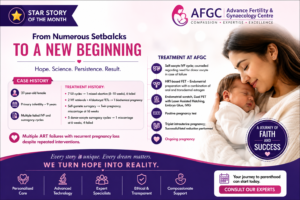
 A 37-year-old woman with a 9-year history of primary infertility presented with recurrent pregnancy loss and repeated failure of assisted reproductive technology, despite multiple IVF and surrogacy cycles. She had regular menstrual cycles, and her partner’s semen analysis was within normal limits.
She initially underwent seven IUI cycles, achieving conception during the first cycle, which resulted in a missed abortion at 8–10 weeks’ gestation for which she underwent suction and evacuation. The remaining six IUI cycles were unsuccessful.
She subsequently underwent IVF, with two oocyte retrievals followed by four frozen embryo transfers (FETs), with all embryos transferred at the blastocyst (Day 5) stage. Her first IVF conception in 2019 resulted in a biochemical pregnancy.
Owing to repeated implantation failure and pregnancy loss, the couple opted for gestational surrogacy. A self-gamete surrogacy cycle resulted in a twin pregnancy, which ended in a spontaneous miscarriage at 16 weeks’ gestation. She subsequently underwent five donor-oocyte surrogacy cycles, one of which resulted in a singleton pregnancy that ended in a spontaneous miscarriage at 6 weeks’ gestation, while the remaining donor cycles failed to achieve an ongoing pregnancy.
She had previously undergone two hysteroscopic procedures, during which the uterus was noted to be acutely retroverted, with the cervical os negotiated with difficulty. Evaluation for RPL, including thrombophilia and antiphospholipid antibody screening, was unremarkable.
Given the cumulative adverse prognostic factors, including prolonged infertility, recurrent pregnancy loss and repeated ART failure, the couple were explained regarding the limited probability of success. After comprehensive counselling, they opted to proceed with one final autologous IVF cycle with the understanding that donor-oocyte IVF would be considered in the event of treatment failure. Ovarian stimulation was performed using a GnRH antagonist protocol, consisting of recombinant FSH 150 IU plus HMG 225 IU daily for 5 days, followed by recombinant FSH 120 IU plus HMG 225 IU daily for another 5 days. Final oocyte maturation was achieved using a dual trigger with hCG 10,000 IU and leuprolide acetate 0.2 mg. A total of five cleavage-stage embryos were vitrified, comprising three Grade A and two Grade B 8-cell embryos. Although a fresh embryo transfer was initially planned, it was deferred, and all embryos were vitrified.
A subsequent hormone replacement therapy (HRT)-based frozen embryo transfer cycle was undertaken. An endometrial scratch was performed prior to embryo transfer. Endometrial preparation was achieved using a combination of oral estradiol valerate and vaginal estradiol gel, resulting in an optimal endometrial thickness of 9.5 mm after 12 days of estrogen therapy. In view of her history of RIF and RPL, an individualized embryo transfer strategy was adopted. Following detailed counselling regarding the potential benefits and limitations of the proposed adjunctive interventions, she underwent a dual embryo transfer, comprising a sequential transfer of cleavage-stage embryos on Day 3 followed by a blastocyst transfer on Day 6. Laser-assisted hatching was also performed prior to embryo transfer, and the embryos were transferred using embryo glue. As an adjunctive immunomodulatory intervention, intravenous immunoglobulin (IVIG) was administered on the day of the first embryo transfer.
Luteal phase support consisted of intramuscular progesterone on alternate days, vaginal micronized progesterone daily, oral estradiol valerate 2 mg alternating with transdermal estradiol gel, low-dose aspirin, prednisolone, and low-molecular-weight heparin (LMWH) administered on alternate days.
Fourteen days following embryo transfer, serum β-hCG was positive, and subsequent transvaginal ultrasonography confirmed a triplet intrauterine pregnancy with fetal cardiac activity in all three fetuses. IVIG was repeated following a positive β-hCG test and again at the first ultrasound confirming fetal cardiac activity. Given the higher order multiple gestation, the patient was referred to a fetal medicine specialist for multifetal pregnancy reduction. The procedure was performed successfully and the pregnancy has since progressed uneventfully, and is currently ongoing.
This case highlights the challenges associated with managing recurrent implantation failure and recurrent pregnancy loss following multiple unsuccessful ART attempts. It underscores the importance of an individualized, patient-centered treatment strategy, with careful selection of adjunctive interventions aimed at optimizing endometrial receptivity and implantation in selected patients with a poor reproductive prognosis.