
Case Presentation
A 37-year-old nulligravid woman presented to our fertility clinic with primary infertility of 11 years’ duration. She was a known case of Type II diabetes mellitus on medical management. Three years prior to presentation, she had undergone laparoscopic myomectomy for symptomatic uterine fibroids at another tertiary care center. Despite regular unprotected intercourse throughout her married life and previous surgical intervention, conception had not been achieved. 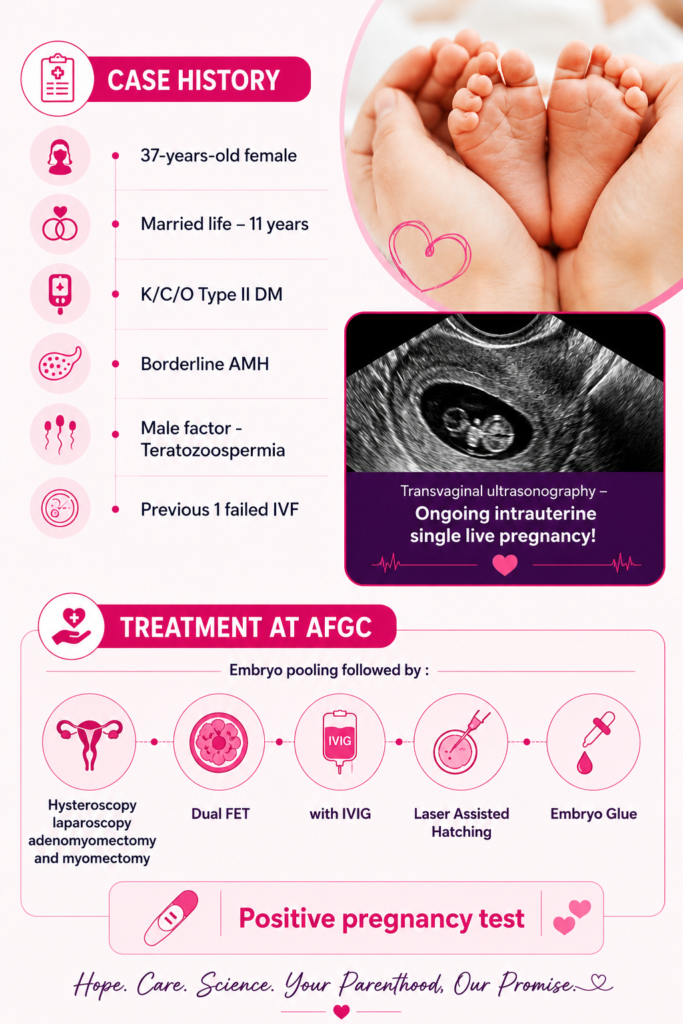
On presentation, a comprehensive infertility evaluation was performed. Assessment of ovarian reserve demonstrated a borderline Anti-Müllerian Hormone (AMH) level of 1.84 ng/mL.. Semen analysis of her husband revealed isolated teratozoospermia, while other semen parameters were within acceptable limits. The couple therefore had multiple contributory infertility factors, including advanced maternal age, borderline ovarian reserve, long-standing Type II diabetes mellitus, previous uterine surgery, and male factor infertility.
Considering the prolonged duration of infertility and the cumulative adverse prognostic factors, the couple was counselled regarding the relatively low probability of spontaneous conception. After detailed discussion, they elected to proceed with in vitro fertilization (IVF) as the treatment modality most likely to provide successful pregnancy.
The patient underwent her first IVF cycle using a GnRH antagonist ovarian stimulation protocol consisting of recombinant follicle-stimulating hormone (rFSH) 200 IU/day combined with human menopausal gonadotropin (HMG) 225 IU/day. Follicular development was satisfactory, and oocyte retrieval was successfully performed. Good-quality Day 5 blastocysts were obtained and cryopreserved. Subsequently, a hormonally prepared frozen embryo transfer (FET) cycle was undertaken following adequate endometrial preparation. Despite an apparently uncomplicated embryo transfer and satisfactory luteal phase support, serum β-hCG remained negative, indicating implantation failure.
Rather than immediately proceeding with another embryo transfer, a multidisciplinary review of the patient’s clinical profile was undertaken. It was recognized that several potentially modifiable factors could be optimized before future treatment attempts. The patient was therefore advised a planned treatment interval of approximately two months, during which intensive efforts were directed toward improving her metabolic status. She underwent supervised dietary modification, structured exercise, and diabetic optimization under endocrinology guidance. During this period, she achieved clinically meaningful weight reduction and tight glycaemic control, thereby reducing one of the important risk factors known to adversely influence implantation and pregnancy outcomes.
Following metabolic optimization, the clinical team adopted an embryo pooling strategy to maximize cumulative embryo availability in view of the patient’s borderline ovarian reserve and advancing reproductive age. Two additional antagonist IVF stimulation cycles were subsequently performed using individualized stimulation protocols. Embryos obtained from these cycles were cryopreserved, thereby increasing the number of embryos available for future transfer without compromising embryo quality.
Despite improved embryo availability, persistent concern remained regarding the uterine environment as a possible contributor to the previous implantation failure. Further imaging and clinical assessment demonstrated residual fibroids together with significant adenomyosis, both of which were considered likely to impair endometrial receptivity and successful implantation.
The patient therefore underwent combined hysteroscopic and laparoscopic surgery, during which residual fibroids were excised and adenomyomectomy and adhesiolysis was performed to restore normal uterine anatomy as far as feasible. The postoperative period was uneventful. Recognizing the known adverse impact of adenomyosis on implantation and miscarriage rates, prolonged suppression of residual adenomyotic activity was undertaken using two monthly doses of leuprolide acetate depot (3.75 mg) prior to planning embryo transfer.
Following completion of downregulation, a hormone replacement therapy (HRT)-based frozen embryo transfer protocol was initiated. Endometrial preparation was carefully monitored by serial transvaginal ultrasonography until an optimal trilaminar endometrium measuring 9 mm was achieved. Progesterone supplementation was then commenced according to institutional protocol to synchronize endometrial receptivity with embryo development.
After thorough counselling regarding the potential benefits and limitations of adjunctive implantation-enhancing techniques, the patient underwent Dual transfer under ultrasound guidance. Laser-assisted hatching was performed prior to transfer, and embryos were transferred using Embryo Glue, in accordance with the clinic’s individualized treatment protocol. Considering the patient’s history of previous implantation failure and multiple adverse prognostic factors, intravenous immunoglobulin (IVIG) therapy was administered as an adjunctive immunomodulatory treatment after appropriate informed consent.
Fourteen days after embryo transfer, serum β-human chorionic gonadotropin (β-hCG) measured 450 mIU/mL, indicating successful implantation. Serial β-hCG measurements demonstrated appropriate doubling kinetics consistent with a viable early pregnancy. Transvaginal ultrasonography subsequently confirmed a single intrauterine gestational sac with a live embryo and normal fetal cardiac activity, establishing an ongoing singleton pregnancy.
In accordance with the individualized treatment plan, IVIG therapy was repeated after biochemical confirmation of pregnancy and again following documentation of fetal cardiac activity. The patient remained clinically stable throughout the first trimester without any significant obstetric complications.
She has now successfully completed the first trimester with a viable singleton pregnancy and continued routine antenatal care under the supervision of a high-risk obstetric team. Ongoing surveillance has demonstrated satisfactory fetal growth and maternal well-being. This favorable outcome was achieved following a carefully planned, sequential, and individualized management strategy addressing embryo competence, metabolic optimization, correction of uterine pathology, enhancement of endometrial receptivity, and comprehensive multidisciplinary care.