
One of the most common questions couples ask before starting IVF is: “What is my chance of success?” The honest answer is that IVF success rate is not a single fixed number. It depends on several important factors, and the same percentage cannot be applied to every couple.
The most important factor is usually the age of the woman, because egg number and egg quality decline with age. However, age is not the only factor. IVF success also depends on AMH, antral follicle count, egg quality, sperm quality, embryo quality, endometrial thickness and receptivity, uterine health, previous IVF history, and associated conditions such as endometriosis, adenomyosis, fibroids or hydrosalpinx.
A 28-year-old woman will usually have a better chance than a 42-year-old woman if all other factors are favourable. However, this is not always so simple. For example, a young woman with very poor ovarian reserve, poor egg quality or a persistently thin endometrium may have a lower chance of success. On the other hand, a 37-year-old woman with good AMH, good-quality embryos, a healthy endometrium and good sperm parameters may still have a very reasonable chance of pregnancy.
Very important: age-based success rates apply only when all other factors are reasonably good and optimum. If egg quality, sperm quality, embryo quality, uterine cavity, endometrium or general health factors are compromised, the success rate can reduce at any age.
In general, when all parameters are favourable, the chance of success per embryo transfer may be higher in women below 30 years, often around 50–60% in good-prognosis cases. It gradually reduces with age: around 30–33 years, 33–35 years, 35–37 years, 38–39 years, 40–42 years, and more than 42 years. By the early forties, even with IVF, the success rate per embryo transfer may reduce significantly, sometimes to around 10–15%, especially when using self-eggs.
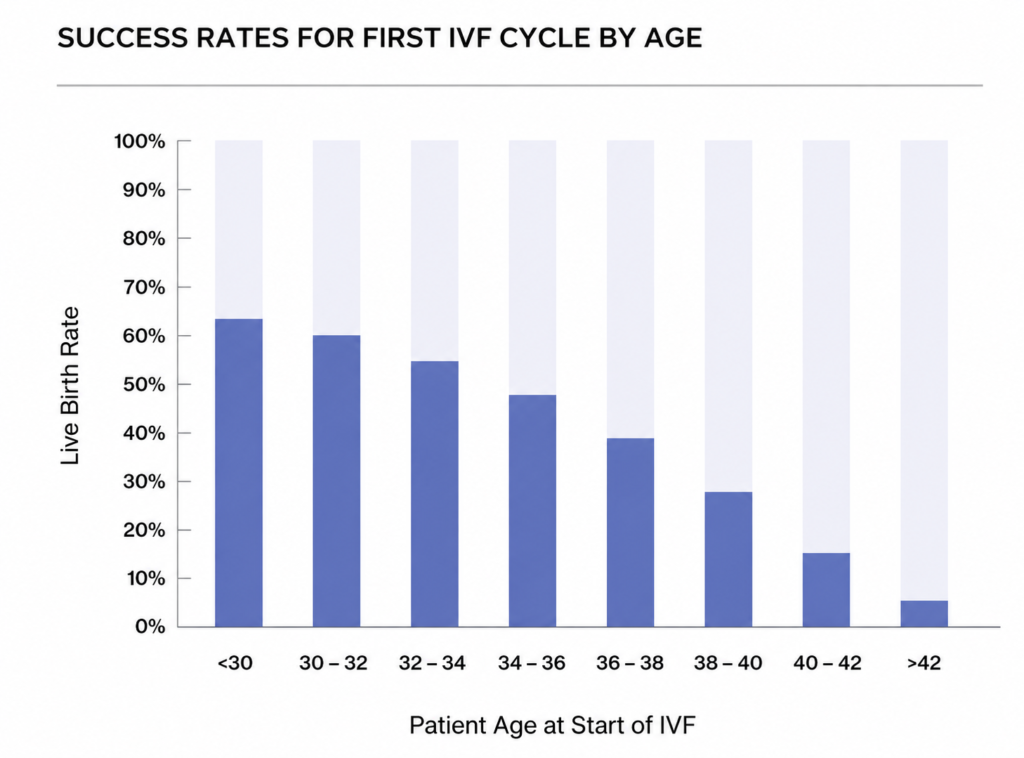
Fig 1- IVF success rate by female age group, assuming egg, sperm, embryo and endometrium are favourable
Another important concept is cumulative success rate. IVF should not always be judged by only one embryo transfer. Sometimes pregnancy happens in the first attempt. Sometimes it happens in the second or third embryo transfer. If a couple has more than one good embryo, their cumulative chance over 2–3 embryo transfer attempts may be much higher than the chance in one single transfer.
However, no clinic or doctor can honestly promise 100% success. IVF is a scientific treatment, but it is also biological, and biology cannot be guaranteed. Claims such as “guaranteed IVF success” or “100% pregnancy” are misleading and unethical.
The right approach is to give every couple an individualized assessment, explain realistic chances, optimize all correctable factors, and then proceed with a carefully planned IVF cycle. A transparent discussion about success rate helps couples begin treatment with hope, but also with realistic expectations.
References
- Society for Assisted Reproductive Technology. Success Rates. SART; accessed 2026 Jun 10.
- Practice Committee of the American Society for Reproductive Medicine. Optimizing natural fertility: a committee opinion. Fertil Steril. 2022.
- Dr Kaberi Banerjee. IVF Treatment, Success Rate & Cost. Dr Kaberi Banerjee website; 2025.
- Malizia BA, Hacker MR, Penzias AS. Cumulative live-birth rates after in vitro fertilization. N Engl J Med. 2009;360(3):236-243.
- Stern JE, Brown MB, Luke B, Wantman E, Lederman A, Missmer SA, et al. Calculating cumulative live-birth rates from linked cycles of assisted reproductive technology. Fertil Steril. 2010;94(4):1334-