
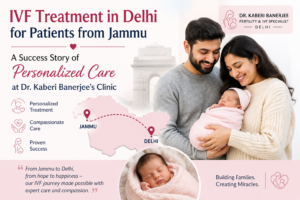
 For couples travelling from Jammu to Delhi for IVF, one of the biggest concerns is repeated travel. Many patients ask whether fertility treatment can be started online and completed with fewer visits. While online consultation is useful for reviewing reports and planning, in cases of previous failed IVF, at least one visit to the main IVF centre is very important. A detailed examination can sometimes reveal factors that may be missed on reports alone.
This is the story of Mrs. Neha Sharma, Jammu — name changed, aged 35 years, and her husband, aged 38 years. They had been trying to conceive for eight years. Mrs. Sharma had polycystic ovaries and irregular ovulation. Her husband’s semen analysis showed moderately reduced sperm count and motility. The couple had already undergone two IVF cycles elsewhere, but both had failed.
A friend from Jammu recommended Dr. Kaberi Banerjee and Advance Fertility & Gynecology Centre, Delhi. The couple wanted expert IVF care but were worried about taking too much time away from their demanding jobs. They requested whether some part of the treatment could be coordinated from Jammu.
Dr. Banerjee advised them to first visit the Delhi centre for a complete assessment. This was especially important because they had already had two failed IVF cycles. During the visit, Mrs. Sharma underwent a detailed ultrasound and clinical review. Her reports, AMH, hormone profile, previous IVF records, semen analysis and treatment history were checked carefully.
Importantly, the scan did not show hydrosalpinx, endometrial polyp or fibroid affecting the cavity. These are important factors to rule out before repeating IVF, because they may reduce implantation and pregnancy chances. After this detailed evaluation, Dr. Banerjee planned an individualized antagonist IVF protocol and decided the medication doses.
The couple collected the prescribed gonadotropin injections and antagonist medicines and returned to Jammu. From Day 1 or Day 2 of her next menstrual cycle, Mrs. Sharma started stimulation injections in Jammu as advised. Ultrasound monitoring was done locally for the first 7–8 days, and the reports were shared with the Delhi team. This helped reduce unnecessary travel while keeping the treatment medically supervised.
Once the follicles were close to maturity, the couple travelled to Delhi for the final 3–4 days of monitoring. Because Mrs. Sharma had polycystic ovaries, careful stimulation was essential to avoid ovarian hyperstimulation. A Lupride trigger was planned for safety.
At egg pickup, 14 eggs were retrieved. ICSI was performed because of the male-factor component. Seven good embryos developed and were frozen in two straws. Since the endometrium was not developing optimally during the stimulation cycle, a fresh embryo transfer was not done. This was an important decision. IVF success depends not only on embryos, but also on the uterine lining being properly prepared.
In the next cycle, the uterus was prepared more carefully. A long protocol with Lupride suppression was used, followed by estradiol valerate 2 mg three times daily. When the endometrium reached 8 mm, progesterone support was added. After proper preparation, two blastocysts were transferred on Day 5. Intravenous immunoglobulin was also given after counselling for immune regulation, as clinically indicated.
Fourteen days later, the beta-hCG was positive at 362. Two weeks after the positive pregnancy test, ultrasound showed a single intrauterine pregnancy with a live heartbeat. After eight years of infertility and two previous IVF failures, the couple finally had a positive outcome.
Eight months later, they delivered a healthy baby girl.
This story highlights an important message for patients from Jammu: IVF treatment in Delhi can be planned in a practical and individualized way. For patients with previous failed IVF, one detailed visit to the main centre is strongly advisable before starting treatment. Once the case is assessed properly and the protocol is decided, selected parts of the cycle may sometimes be coordinated locally, depending on the patient’s condition and safety.
At Advance Fertility & Gynecology Centre, Delhi, treatment is not offered as a standard package for everyone. Each couple is evaluated individually. Age, AMH, ovarian response, sperm quality, previous IVF history, uterine cavity, endometrium and medical background are all considered before deciding the plan.
For couples from Jammu struggling with PCOS, male-factor infertility, repeated IVF failure or long-standing infertility, Dr. Kaberi Banerjee’s approach focuses on detailed assessment, advanced IVF laboratory support, transparent planning and minimizing unnecessary visits whenever medically appropriate.
Patient identity changed. Clinical details adapted for privacy. Outcome shared as a representative success story.