
Surrogacy is an important option for selected couples and women who are unable to carry a pregnancy because of a serious medical or uterine condition. It is not the first step in infertility treatment, and it is not recommended simply because conception has taken time. Usually, couples are assessed for simpler and less invasive options first, including fertility treatment, IVF, surgery where appropriate, and embryo transfer into the intending mother’s own uterus.
In India, surrogacy is permitted only within a regulated legal and medical framework. Therefore, a recommendation for surrogacy must be based on a genuine medical indication and supported by the required certification and approvals. Each case needs individual assessment by the fertility specialist and the relevant medical board. 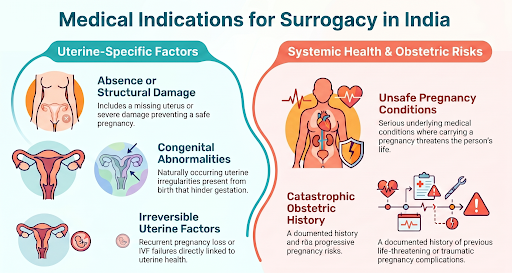
Absence of the Uterus
One of the clearest indications for surrogacy is absence of the uterus. Some women are born without a uterus, as seen in Mayer-Rokitansky-Küster-Hauser (MRKH) syndrome. Others may have had their uterus removed because of severe fibroids, uncontrollable bleeding after delivery, cancer, infection, or another life-saving medical reason.
When the ovaries are functioning and eggs can be obtained, embryos may be created through IVF using the intended parents’ gametes, where legally permitted, and transferred into the surrogate mother’s uterus.
Severe Uterine Damage or a Uterus Unable to Carry Pregnancy
Some women have a uterus but are unable to carry a pregnancy safely because the uterine cavity is severely damaged. This may occur after severe intrauterine adhesions, also called Asherman syndrome, repeated curettage, genital tuberculosis, severe infection, previous surgery, or extensive scarring of the uterine lining.
In some cases, repeated attempts at hysteroscopic treatment and carefully planned embryo transfer may be considered first. However, if the endometrium remains severely damaged or the uterine cavity cannot be restored adequately, surrogacy may be discussed as an alternative route to parenthood.
Serious Medical Conditions Where Pregnancy Is Unsafe
Surrogacy may also be considered when pregnancy could place the intending mother at substantial risk to her health or life. Examples may include serious heart disease, significant kidney disease, severe pulmonary hypertension, advanced liver disease, certain neurological disorders, or medical conditions in which pregnancy is strongly discouraged by the treating physician.
Women who have undergone major medical treatment, including certain cancer treatments or organ transplantation, may also require detailed pre-pregnancy evaluation. In selected situations, pregnancy may be medically unsafe even when the woman is otherwise well and has embryos available. The decision should always be made jointly with the relevant medical specialists, rather than based on fertility concerns alone.
Repeated IVF Failure and Recurrent Pregnancy Loss
Repeated IVF failure or recurrent pregnancy loss can be emotionally devastating. However, these situations do not automatically mean that surrogacy is necessary. The cause must first be investigated carefully. Embryo quality, age-related egg factors, sperm factors, uterine cavity, endometrial receptivity, adenomyosis, fibroids, hydrosalpinx, hormonal conditions and genetic factors may all need evaluation.
Surrogacy may be considered when repeated embryo transfer failures or repeated pregnancy losses are clearly linked to a uterine factor that cannot be corrected, or where carrying a pregnancy is medically unsafe. The aim is not to bypass a treatable problem but to identify when another uterus may offer a more realistic possibility of a healthy pregnancy.
Congenital Uterine Abnormalities and Severe Obstetric History
Some women have major congenital uterine abnormalities, such as a severely malformed or underdeveloped uterus, where the chance of safely carrying a pregnancy may be very low. Others may have a previous history of catastrophic obstetric complications, including severe placental problems, uterine rupture, or life-threatening bleeding, making another pregnancy unsafe.
These are complex decisions. A full review of past pregnancy records, operative notes, imaging and opinions from obstetric and medical specialists is essential before considering surrogacy.
A Carefully Individualised Decision
Surrogacy is a major medical, emotional and legal journey. It should be recommended only after a thorough evaluation and transparent discussion of all options. Couples should understand that successful surrogacy also depends on embryo quality, the surrogate mother’s health, careful antenatal care and compliance with the legal process.
At Surrogacy Services, every case is assessed individually. The objective is to recommend surrogacy only when there is a clear medical reason, to guide intended parents through a lawful process, and to ensure that the surrogate mother receives respectful, ethical and comprehensive care throughout the journey.
References
- Government of India. The Surrogacy (Regulation) Act, 2021. New Delhi: Ministry of Law and Justice; 2021.
- Government of India. Surrogacy (Regulation) Rules, 2022. New Delhi: Ministry of Health and Family Welfare; 2022.
- National ART and Surrogacy Registry. Government of India. Available from: https://registry.artsurrogacy.gov.in/
- Banerjee K. What are the indications of surrogacy? Medtalks. 2021. Available from: https://www.medtalks.in/articles/what-are-the-indications-of-surrogacy
- Practice Committee of the American Society for Reproductive Medicine. Uterine transplantation: a committee opinion. Fertil Steril. 2018;110(4):605-610.
- Brännström M, Dahm-Kähler P. Uterus transplantation and surrogacy: ethical and clinical considerations. Best Pract Res Clin Obstet Gynaecol. 2021;70:48-57.
- Banerjee K. Surrogacy Services: Information and Support for Intended Parents. Available from: surrogacyservices.net.
- Banerjee K, Singla B, Verma P. Successful Retrieval of Oocytes followed by Surrogacy in Hypogonadotropic Hypogonadism.
Published in 2020. It is indexed in PubMed Central. - Banerjee K, Singla B. Successful retrieval of oocytes from renal transplant recipient followed by surrogacy.
Published in 2020. - Banerjee K. A retrospective study of different endometrial preparation protocols and its impact on the outcome of frozen embryo transfer, donor recipient and surrogacy cycles. JPOG. 2016;7:155-59.
- Banerjee K, Singla B. Correlation of visualization of post embryo transfer air bubble with pregnancy rate.Journal of IVF-Worldwide. 2023;1(4). doi:10.46989/001c.89303.