
Polycystic Ovary Syndrome (PCOS) is one of the most common hormonal disorders affecting women of reproductive age and is a leading cause of infertility. It affects approximately 1 in 10 women, and in many cases, it is the underlying reason for difficulty in conceiving.
What Is PCOS? 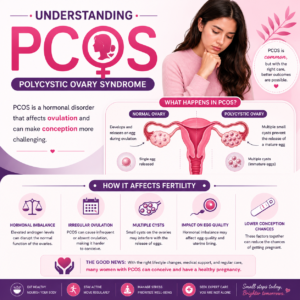
PCOS is a condition characterised by:
- Irregular or absent ovulation
- High androgen (male hormone) levels
- Polycystic ovaries on ultrasound
Women with PCOS often experience irregular periods, acne, weight gain, or excessive hair growth. However, some women may have minimal symptoms and are diagnosed only when they face difficulty conceiving.
As outlined on Advance Fertility, PCOS is not just a reproductive issue—it is also linked to metabolic health, including insulin resistance and increased risk of diabetes.
How PCOS Affects Fertility
The main impact of PCOS on fertility is irregular ovulation.
- Many women with PCOS do not ovulate regularly
- Without ovulation, there is no egg release for fertilisation
- Hormonal imbalance can also affect egg quality and endometrial receptivity
Additionally, studies suggest that insulin resistance and inflammation in PCOS may negatively influence reproductive outcomes.
Can Women with PCOS Get Pregnant?
Yes—most women with PCOS can conceive, either naturally or with treatment.
In fact:
- Many women respond well to ovulation induction
- Others may require IUI or IVF
Interestingly, in IVF cycles, women with PCOS often produce:
- More eggs
- Comparable pregnancy rates to women without PCOS
However, careful management is needed to avoid complications like ovarian hyperstimulation syndrome (OHSS).
Role of IVF in PCOS
IVF is highly effective in PCOS when:
- Ovulation induction fails
- There are additional factors like tubal or male infertility
Studies show that clinical pregnancy and live birth rates in PCOS are similar to non-PCOS patients when protocols are optimised .
However:
- Egg quality may sometimes be affected due to hormonal imbalance
- Risk of complications like OHSS is higher
This is why modern IVF protocols in PCOS focus on:
- Mild stimulation
- GnRH agonist trigger
- Freeze-all strategies
Lifestyle and Medical Management
Lifestyle plays a crucial role in PCOS management:
- Weight control significantly improves ovulation
- Regular exercise improves insulin sensitivity
- Balanced diet reduces hormonal imbalance
Medical treatment may include:
- Ovulation induction drugs
- Insulin-sensitising agents
- IVF when required
Even small lifestyle improvements can significantly enhance fertility outcomes.
Final Takeaway
PCOS can affect fertility, but it is one of the most treatable causes of infertility.
With the right approach:
- Natural conception is possible
- Assisted treatments are highly effective
The key lies in early diagnosis, lifestyle management, and individualised treatment planning.
References
- Kotlyar AM, et al. Women with PCOS who undergo IVF. 2023.
- Patel SS, et al. Oocyte quality in polycystic ovary syndrome. 2008.
- Heijnen EM, et al. IVF outcomes in PCOS: a meta-analysis. Hum Reprod. 2006.
- Sha T, et al. Pregnancy outcomes in PCOS patients undergoing IVF. Reprod Biomed Online. 2019.
- Tang K, et al. IVF effectiveness in PCOS patients. 2021.
- Thakre N, et al. IVF protocols in PCOS and OHSS prevention. 2019.
- Mai Z, et al. IVF outcomes in PCOS vs non-PCOS patients. 2021.
- Yuwen T, et al. AMH levels and IVF outcomes in PCOS. 2023.
- Sharma R, et al. Lifestyle factors in reproductive health. Indian J Med Res. 2019.